Easy Way to Solve Polar Form to Rectangular Form
If polar equations have you second-guessing your future as a nuclear physicist, fret not! About every pre-calculus student I have tutored has struggled here, and it isn't surprising at all. Remember the first time y'all saw an equation and were introduced to these foreign x and y variables? It may seem like second nature now, but you were learning nearly a whole new way to communicate well-nigh points and curves. Polar equations are no dissimilar. And I have expert news! Y'all already have all the tools y'all need to learn to express equations in polar form. In fact, you've been learning them for years; you lot take simply been using them differently. Today, I'll discuss a foolproof method - Cambridge Coaching's Five Step Procedure for converting polar to Cartesian equations. Polar coordinates exist to make it easier to communicate where a point is located. Allow'south expect at a quick example. Ignore the circles on the plot for a 2d and moving picture the rectangular system yous're familiar with. Where would you put the indicate (3,4)? If you lot would put it past the red dot, you're correct. [image missing] By now, you lot know that the red dot can besides be represented as (5,0.92) in polar coordinates. If we wanted to move the dot to the 30° line, while maintaining our distance of 5 units from the origin (the blue dot), nosotros could simply express it as (5,30°) or (5,𝝅/6) in polar coordinates. If we were to limited it in rectangular coordinates, the calculation would require a few extra steps. So, although polar coordinates seem to complicate things when you are first introduced to them, learning to use them tin can simplify math for you quite a bit! Similarly, converting an equation from polar to rectangular form and vice versa tin help you express a curve more than just. Follow these five steps to convert equations between the polar and rectangular systems: A quick glance at your equation should tell you what grade it is in.If information technology contains rs and θs, information technology is in polar class. If it contains xs and ys, it is in rectangular form. If your equation is in polar form, your goal is to convert information technology in such a way that you are only left with xs and ys. If it is in rectangular form, your goal is to only accept rs and θs.It sounds simple, simply reminding yourself of your goal volition help yous avoid getting stuck half way through converting your equation (or going around in circles) . Now, accept a moment to examine your equation. Here are some key components you should exist looking for. If they are non nowadays in your equation, you should be thinking about how you lot might be able to make them appear. Begetting in heed the goal y'all set in Step two, begin to substitute. Simplify your equation by combining like terms. Where appropriate, mostly if you have x2s and y2s, think about completing the square. Where possible, a fully simplified equation will limited r in terms of θ or y in terms of x, but this will sometimes be incommunicable without truly ridiculous amounts of manipulation. Let's employ this method to a few examples. This is a polar equation. Our goal is to arrive at an equation that but contains ten and y terms. Looking at the equation above, the right-paw side (RHS) could turn into rsin(θ), but is missing an r term. The left-mitt side (LHS) could turn into 5r2, but is also missing an r term. Aha! Since both the LHS and RHS are missing the same term, let's multiply both sides by r. 5r=sin(θ) 5r2=rsin(θ) At present that we take an equation with terms that can exist converted easily, we can brainstorm to substitute. 5r2=rsin(θ) 5(x2+y2)=y Finally, we combine like terms and simplify the equation. Our effect is by and large simplified, simply we can take a few more steps. Some mathematicians will inquire that the RHS be set to zero if the equation is truly simplified. Others will ask that any recurring term exist factored out. All 3 equations beneath are in varying degrees of simplification. v(x2+y2)=y 5x2+5y2-y=0 5x2+y(5y-1)=0 This is a polar equation. Our goal is to get in at an equation that just contains x and y terms. Looking at the equation higher up, let's first rearrange it so that the trigonometric terms are on the RHS. 3r-cos2(θ)=sin2(θ) 3r=sin2(θ)+cos2(θ) See anything familiar? The RHS tin be simplified to 1 using a pythagorean identity. 3r=i How tin we turn the LHS into r2? We have two options: we can either multiply both sides by r or foursquare both sides. Multiplying both side past r would mean that the RHS cannot be easily converted. If nosotros square both sides instead, the equation is easier to solve. (3r)ii=12 9r2=1 Now that we have an equation with terms that can exist converted easily, nosotros tin can begin to substitute. 9r2=1 9(x2+y2)=1 Finally, we combine similar terms and simplify the equation. Notice that you will arrive at the equation for a circumvolve with a radius of ane/3. Wasn't 9r2=1 or r=1/iii a simpler way to show it? This is why polar equations can exist so helpful! 9(x2+y2)=ane x2+y2=1/9 This is a rectangular equation. Our goal is to arrive at an equation that only contains r and θ terms. Converting from rectangular form to polar class is much easier! Looking at the equation above, we tin group the second-order terms in grooming to convert them to r2. x2+3x+y2=6 (x2+y2)+3x=6 Substitute for all x and y terms. (x2+y2)+3x=half-dozen r2+3rcos(θ)=6 We could accept the simplification on step further hither, but that is non necessary. Both answers have been shown below. r2+3rcos(θ)=6 r(r+3cos(θ))=half-dozen And in that location you lot take it! Follow our 5 Step Process whenever converting Polar to Cartesian equations and presently plenty it'll become 2nd nature!Why do Polar Coordinates and Equations exist?
Footstep 1: Identify the form of your equation
Step two: State your goal
Pace 3: Examine your equation
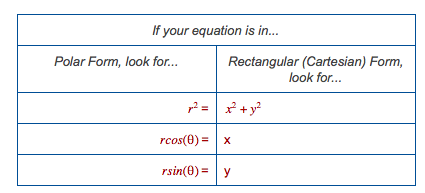
Step 4: Substitute away!
Step five: Combine like terms and complete squares (where needed)
Hither are some examples!
Example 1: 5r=sin(θ)
Step i:
Step 2:
Step three:
Step iv:
Step 5:
Example two: 3r-cos2(θ)=sin2(θ)
Step ane:
Pace two:
Step 3:
Stride 4:
Footstep 5:
Case 3: x2+3x+y2=6
Step 1:
Step 2:
Step 3:
Footstep 4:
Step 5:
Source: https://blog.cambridgecoaching.com/converting-polar-to-cartesian-equations-in-five-easy-steps

Posting Komentar untuk "Easy Way to Solve Polar Form to Rectangular Form"